Florida Atlantic University’s Center for Environmental Studies will be hosting
Click here for more info about the 2013 Summit!
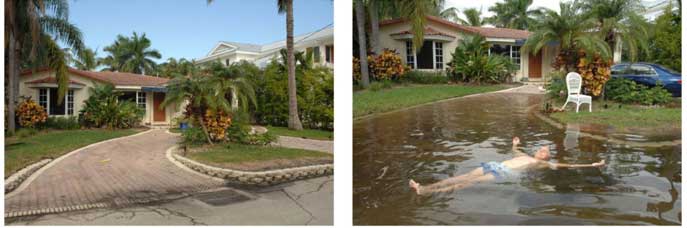
"Forty percent of the nation's sea level rise risk is in Florida," Ben Strauss, Climate Central. Projections even for the short-range future, suggest a steadily growing threat to Florida's infrastructure and ecological treasures. Florida deals with hurricanes, floods, and droughts. Understanding, anticipating, and adapting to these threats is part of the DNA of the region. Now a more insidious threat promises to make Florida one of the world's most vulnerable areas. Sea level rise will continue to damage Florida's coastal ecosystems and its inland water systems. Salt water intrusion into coastal aquifers, failure of vital drainage canals, and periodic flooding at high tides are already newspaper headlines.
About The Summit
On June 21st and 22nd , 2012, The Florida Center for Environmental Studies hosted the “Risk and Response” Sea Level Rise Summit in Boca Raton, Florida with over 300 attendees from private and public agencies. The summit was sponsored by USGS, Florida Sea Grant, The Flora foundation, USF's Patel School for Global Sustainability, Coastal Areas Climate Change Education (CACCE), NOAA, Wells Fargo, NRDC, The Community Foundation of Palm Beach and Martin Counties, RenaissanceRe, The Northeast Regional Council, and The Florida Climate Institute. The purpose of the summit was three-fold:
- To highlight the interrelationships between sea level rise, saltwater intrusion into fresh water aquifers and water management in Florida;
- To share the ongoing responses and adaptation planning of agencies, institutions and civic societies to sea level rise; and
- To compare Florida's challenges and responses with other vulnerable localities in the US and worldwide.
The summit was opened by key note speaker Dr. Margaret Davidson, Director, NOAA Coastal Services Center and the two day event included seven panels that focused on the complex sea level rise issues in Florida and provided examples from other coastal regions within the U.S. and internationally.
Session One: Sea Level Rise and Florida: “A Complex and Unique Relationship”
The highlights of the session included current sea level rise rates, potential acceleration, and impacts that are already being felt.
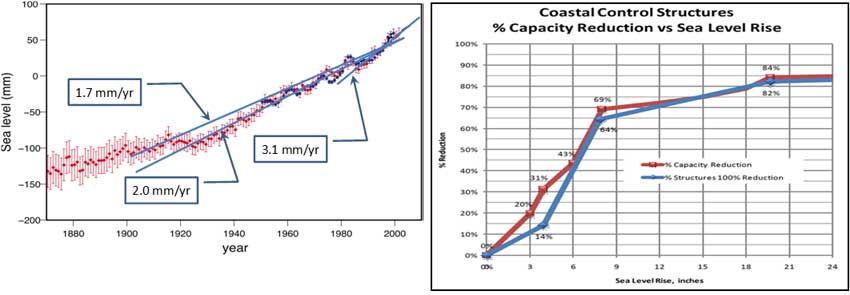
- Sea level is rising and it is expected to accelerate. During much of the last century the global rate of rise is about 1.8mm per year. Since 1990 it has been 3.1 mm per year.
- The state has a high percentage of the nations risk due to these reasons:
- In the US, 4.9 million people live below an elevation of 4 feet, 2.4 million of which are in Florida;
- There are 107 towns and cities in Florida in which over half of the residents live below 4 feet in elevation (Strauss, 2012):
- The limestone geology causes a rapid interaction between rising sea water along the coast, potentially impacting municipal well fields.
- Florida has current and future problems. Current impacts in Southeast Florida include: reduction in capacity of flood control structures (some of which are already experiencing impacts during high tide), salt water intrusion towards fresh water well fields (South Florida's primary source of drinking water), and the landward migration of fresh water wetlands that may experience peat collapse along the coast.
Session Two: Managing Risk: Organizing for an Uncertain Future
The focus of the session was Florida's mitigation and adaptation planning. Goals, such as flood protection and hurricane resilience, have economic and environmental benefits regardless of timing and scope. Key points included:
- Most of the money comes after a catastrophic event. During the redevelopment of areas affected by extreme events, sea level rise adaptations should be integrated into the long term recovery process.
- With climate change, we will see more complexity and less predictability; drivers will re-shape the way risk assessments are performed.
- Projects, such as the Community Resilience System Initiative, incorporate pre-disaster plans that assess vulnerabilities at the community level.
Local communities are already starting to implement sustainability strategies. The City of Punta Gorda's adaptation plan, based on vulnerabilities and adaptations that the community identified and prioritized, integrates planned relocation.
- Exploration of new management options for beach restoration is necessary.
Session Three: Economic Implications: From Insurance to Economic Well-Being
The session highlighted how sea level rise impacts would affect insurance rates, real estate, land use and Florida's coastlines. Insurance in Florida is one of the biggest and most challenging economic issues.
- The panelists emphasized that the insurance industry is aware of sea level rise issues and already beginning to respond. Jeff Williams, Entergy, affirmed that much of the potential costly risk can be avoided by making strategic adaptation investments today.
- The insurance representatives addressed the importance of the insurance companies working with municipalities to plan and mitigate for future impacts instead of avoiding the sea level rise issues.
- Insurance companies struggle with an imbalance between keeping rates affordable while properly managing risk.
- The disaster safety movement and risk communication methods will induce changes in behavior.
Session Four: Impacts on Built Environments: Urban Planning
The panel discussed how urban infrastructure and housing are addressing projected increases in sea level rise.
- Panelists compared the impacts of sea level rise in South Florida, Northeast Florida, and Mexico.
- Each panelist identified an idealized vision for their region's future in which the built environment was reinvented for resilience. This included a redesign approach that focused on the short and long term adaptation for individual structures and organizations. Short term options ranging from water management that reduces flooding to increasing natural coastal defenses by installing mangrove buffers, will only delay the inevitable. However, short term adaptations are necessary to gain time to work on long term modifications like increasing standards and re-engineering coastal buildings to resist storm surge and sea level rise.
- In Miami-Dade alone, there are over 250,000 residential coastal structures, valued over $50 billion, which are currently vulnerable to storm surge (Alvarez, 2012).
- The panel noted that in Florida, there needs to be the same level of active response by officials to sea level rise as there has been in other areas. For example, San Francisco has been addressing sea level rise since 1989, New York is raising subway gutters among other measures, and New Zealand is paying for relocation.
Session Five: Impacts on Built Environments: Water Utilities, Energy, and Transportation
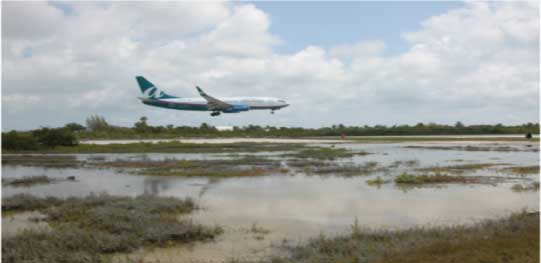
The session focused on how sea level rise would affect transportation, energy, water management and water utilities.
- A recent Florida Department of Transportation study identified roads that are vulnerable to sea level rise and showed that, in some areas, road base materials will fail from saturation long before sea level rise submerges roads.
- Flooding issues, a major concern in Florida, include the malfunction of gravity sewers due to inundation. This will require additional pumps to be installed, and therefore a large energy demand to power them. There are conflicts with current goals versus long term planning. For example, FPL had placed systems underground to avoid wind damage, but sea level rise is now a problem for these underground connections which decay with saltwater intrusion.
- New York City has developed an adaptation plan that balances climate change responses and it has attracted both political and professional support. The panelists identified the need to focus on risk management, which means reducing unacceptable risks to a tolerable level of risk.
- Agencies should be trained to identify the best risk management options for their scenario and how best to implement them. Choosing the “best” alternative requires a comparison of decision criteria-like benefits, costs, and probability of impacts. A single adaptation will seldom reduce risk to an acceptable level, therefore, risk management options often consist of multiple risk management strategies.
Session Six: Collaboration: Organizational Structures
Effective adaptation and mitigation programs and the importance of regional and local partnerships were the topics of this session. The key consensus was that climate change is not just an environmental issue, but also an economic imperative, requiring both mitigation and adaptation.
- Examples included the adaptive strategies of the Bay Area Plan in San Francisco. A map of the bay indicated the 240 square miles that had been filled during development and then showed them submerged due to projected sea level rise. The proposed adaptation is a triage-style solution in which areas are selected for either focused growth or limited development.
- The South Florida Regional Climate Compact is another example whose accomplishments range from mapping inundation and identifying regionally relevant infrastructure, to creating a regional greenhouse gas inventory, and a unified sea level rise projection. Expansion of the compact includes three counties to the north as part of the Seven50 Resilience Plan. The compact has been viewed as the most effective way of dealing with regional challenges and securing funds to address them. The panel emphasized the importance of maintaining involvement at the state level and of drawing attention to mitigation and energy policies.
- The final presentation was on the Florida Atlantic University's Climate Change Initiative's work on inter-university collaborations. Universities are organized to deal with specific problems, but climate change has such a complex nature that it requires an interdisciplinary approach. The solution is to rethink our partnerships and communication mechanisms, both within and between institutions, to develop interdisciplinary methods for dealing with climate change issues.
Session Seven: Public Engagement: Communication, Outreach and Education
The public outreach and education session examined how climate change issues are being addressed in schools, universities and informal education venues. The session included examples of national climate change resources and networks that can used as models in Florida. The challenges of developing an acceptable climate change message and delivery mechanism for students, teachers, the general public and decision makers were addressed.
- NASA-funded “Climate Science Investigations (CSI): South Florida” focuses on online interactive modules using NASA data to improve climate and science literacy for teachers and students. Students conduct research and develop and deliver an argument regarding current climate change misconceptions.
- At the university level, the Florida State University System (SUS) has developed a comprehensive analysis of climate change education. A white paper was produced that identifies action items that could standardize and enhance climate change education across all SUS universities.
- The NSF-funded Coastal Areas Climate Change Education (CACCE) project aims to create innovative approaches and effective educational resources for teaching and learning about climate change.
- The Florida Aquarium provided many examples of outreach to families and the general public reaching an audience of 75 million per year. Aquariums, museums and zoos are often overlooked when addressing outreach on climate change and need to be included as valuable partners in future efforts.
- The Climate Literacy Network, responsible for the development of the Climate Science Literacy Essential Principles, includes individuals, projects, and organizations working to promote climate literacy. This is a national model that could easily be adapted in Florida.
Conclusion
The summit was concluded with a presentation by prominent climate scientist Michael Mann, Professor of Earth Systems Science at Penn State University. Dr. Mann is the author of the first peer-reviewed article documenting that the level of carbon dioxide in the earth's atmosphere has been increasing more rapidly in the last 100 years-- more than at any other time in history-- and is causing a rapid rise in atmospheric and ocean temperatures. Even though there is thorough and scientifically sound evidence that global warming is happening, there are many people that believe global warming is a myth. Dr. Mann noted how these beliefs and the politicization of the issue are major challenges that scientists are facing and provided gripping examples from his work as a climate scientist.
There was overwhelming enthusiasm and collaboration produced by the summit. Each session came together to form an interdisciplinary mosaic of useful adaptation and resilience plans to address sea level rise impacts on the economy, built environment, and vulnerable communities. The messages were echoed in the media. Coverage was given by local and national news outlets including: Tampabay.com, WPTV, Miami Herald, Fort Worth Star Telegram, The Florida Current, Charlotte Sun Herald, DeSoto Sun Herald, Englewood Sun Herald, Fort Meade Leader, Lake Wales News, North Port Sun Herald, Polk County Democrat, Gainseville Sun, and Venice Gondolier.
The key messages were the importance of education to increase awareness and creating partnerships to induce cost-effective best management practices that minimize risk. Compared to other parts of the world, Florida's projections of sea level rise present a complex challenge for municipalities, agencies and decision makers. Florida's unique location and geology require significant and innovative adaptations in infrastructure as sea level rises. Agencies, institutions, and government organizations are already responding to the reality of sea level rise. CES is continuing to work with its partners to identify and address the critical sea level rise issues discussed in each session. Please visit http://www.ces.fau.edu for updates. A full report of the summit will be available this fall.